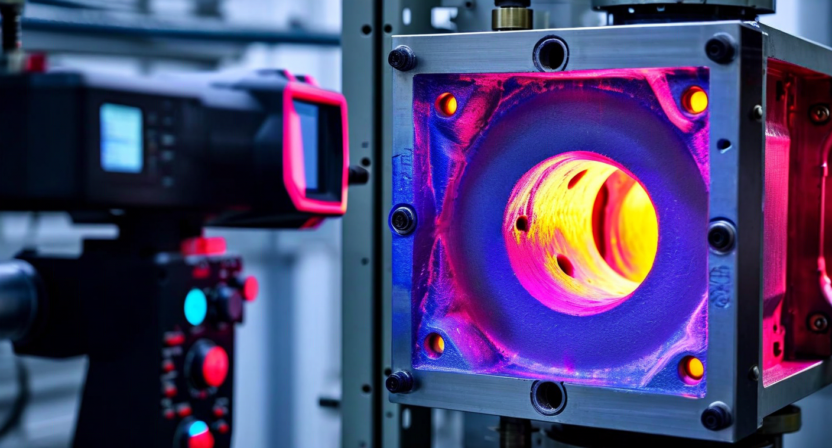
What Thermal Cameras Measure in Die Casting
Infrared cameras measure emitted thermal radiation from surfaces. In the mid-wave infrared (MWIR, 3-5 um wavelength) and long-wave infrared (LWIR, 8-14 um wavelength) bands used for industrial thermography, the camera measures radiance and converts it to temperature using the surface emissivity of the material. Aluminum has an emissivity that varies significantly with surface condition (0.02-0.05 for polished aluminum, 0.3-0.4 for oxidized aluminum surfaces), which requires calibration for accurate temperature measurement but is manageable with consistent measurement conditions.
In a die casting operation, there are two natural measurement points for thermal imaging. The first is the open die cavity immediately after part ejection, before die lubricant application. This measures the die surface temperature distribution, which reveals cooling channel effectiveness, hot spots from inadequate cooling design, and progressive die temperature changes across a production run. The second is the ejected part immediately after ejection, which reveals part temperature distribution, solidification uniformity, and early indicators of porosity hot spots (areas that are still above liquidus temperature while the rest of the part has solidified).
Each measurement point provides different information and requires different camera positioning and timing. Die cavity measurement requires the camera to image the die face during the brief open die window, typically 3-8 seconds in a standard HPDC cycle. Part measurement requires imaging the part on the conveyor or robot gripper within seconds of ejection before it cools too far toward ambient.
Die Temperature Distribution and Cooling Channel Monitoring
The most direct application of thermal imaging in HPDC is monitoring die temperature distribution. In a properly designed die with effective cooling channels, the die surface temperature should return to a controlled setpoint range before each shot. The thermal map of the die face immediately after ejection reveals where this is not happening.
Hot spots - areas where die temperature is elevated relative to the rest of the cavity - indicate either inadequate cooling channel coverage in that region, cooling channel blockage or scale buildup reducing coolant flow, or heat input from the process that exceeds the local cooling capacity. In a steel die with H13 tool steel, sustained hot spots above 250C during the open cycle phase accelerate thermal fatigue and heat checking. The thermal camera identifies these hot spots continuously without requiring the die to be pulled for inspection.
Cooling channel blockage is a maintenance issue that degrades over time. Scale accumulation in water-cooled channels, blocked oil cooling circuits, or failed temperature control zones all show up as progressive hot spot growth on the thermal map across production runs. A thermal monitoring system that tracks die temperature distribution shot-to-shot can identify a cooling degradation trend days before it reaches a severity that affects part quality - enabling scheduled maintenance during a production break rather than emergency die removal after quality problems develop.
The correlation between die hot spot location and casting defect location is direct: areas of the casting that form against a hot spot in the die experience slower solidification, higher shrinkage porosity risk, and different grain structure than areas cooling against a normally-tempered die surface. The thermal data predicts which areas of the casting are at elevated defect risk for the current die thermal state.
Part Thermal Imaging and Solidification Monitoring
Thermal imaging of the ejected part captures the temperature distribution at the moment of ejection, which reflects the solidification history of each section of the casting. In HPDC, the part ejects at temperatures ranging from 200C to 400C depending on part section thickness and die cycle time. The thermal map shows which sections are hotter (thicker, slower-cooling) and which are cooler (thinner, faster-cooling).
The relevant signal for porosity prediction is not absolute temperature but temperature non-uniformity relative to expectations. If a specific region of the casting consistently ejects at a temperature 30-40C higher than the surrounding sections, that region is last to solidify and is a candidate for shrinkage porosity. The thermal measurement provides a continuous, non-contact solidification timing signal that correlates with shrinkage porosity risk without requiring X-ray CT on every part.
This is how ForgePuls uses thermal data in the process correlation engine: not as a standalone defect detector, but as a predictor variable that feeds risk estimates for porosity in specific casting areas. When part thermal imaging shows an anomalous hot zone, the system flags the part for priority visual inspection and CMM check rather than immediately rejecting it. The thermal signal is leading; the defect may or may not be present. The inspection prioritization reduces the escape risk without creating a false rejection from the thermal signal alone.
Measuring Part Temperature for Downstream Process Control
Part temperature at ejection also matters for downstream process steps. Hot trimming (trimming flash while the part is still hot) requires the part to be within a specific temperature window to minimize trimming force and tool wear. If part ejection temperature varies significantly shot-to-shot, trimming quality varies with it. Thermal measurement provides feedback for adjusting die cycle time or cooling duration to maintain consistent ejection temperature.
For parts that go directly to heat treatment after casting, ejection temperature variation affects the time-temperature history the part has seen before entering the heat treatment furnace. While most heat treatment specifications do not account for pre-furnace history, significant variation in initial part temperature can affect the consistency of solution treatment response for age-hardenable alloys.
Linking part thermal data to downstream quality outcomes - heat treatment results, machined dimension stability, pressure test pass rate - requires tracking part serial numbers through the production process. This tracking is possible with part marking (laser or stamp) applied immediately after ejection, combined with barcode or RFID reading at each downstream station. The data linkage is operationally more complex than stand-alone inspection but enables causal analysis that identifies which upstream thermal variables predict downstream quality outcomes.
The Limits of Thermal Imaging
Thermal imaging is not a substitute for surface inspection. It measures temperature distribution, not surface topography or surface defects. A cold shut on the surface of a casting is not detectable by thermal imaging after the part has ejected, because the temperature at a cold shut location is the same as the surrounding material at ejection temperature. Cold shuts form during filling and are fixed features of the cooled casting; they carry no thermal signature at the time of post-ejection thermal imaging.
Similarly, surface cracks, flash variation, and dimensional deviation are not thermal phenomena and are not visible to thermal cameras at the inspection timing relevant for in-process control. Thermal imaging complements visible light inspection - it does not replace it. A complete in-line inspection approach for HPDC uses visible light imaging for surface defect detection and dimensional measurement, and thermal imaging for die temperature monitoring and solidification process control.
The camera placement requirements for the two systems may conflict: optimal thermal die measurement requires a camera facing the open die cavity (looking down the parting line), while optimal surface inspection requires a camera facing the ejected part on the conveyor or robot. Designing the camera layout to accommodate both requirements without interference is part of the installation engineering for a combined visible/thermal inspection system.
Learn about ForgePuls thermal monitoring capabilities: Talk to an Application Engineer