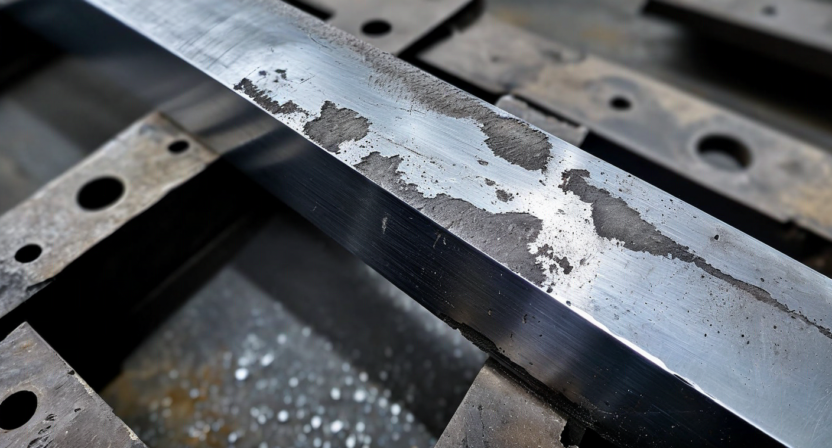
Underfill: Incomplete Die Cavity Fill
Underfill - also called underfilling, short fill, or partial fill - occurs when the forging die cavity is not completely filled with metal before the press reaches its bottom dead center position. The result is a forging with missing or incomplete sections, typically in areas remote from the die entry, in rib tips, or in thin web sections that require metal to travel farthest during die fill.
The root causes of underfill in closed-die forging are: insufficient billet volume (incorrect billet length or diameter for the die design), billet temperature too low for the required flow stress, excessive flash land resistance preventing metal from flowing into remote sections, inadequate ram energy or insufficient number of blow sequences for the preform design, or die lubricant applied too heavily in critical fill areas, increasing friction and impeding metal flow.
Detection of underfill by vision inspection is straightforward for significant underfill: the missing section is geometrically absent and produces a clear silhouette deviation. Minor underfill - partial fill in a rib tip or thin web corner - can be subtle. The detection depends on camera angle relative to the underfilled feature and the surface contrast between the short-filled area and the adjacent fully-filled surface.
For ribs viewed end-on in the inspection image, tip underfill shows as a shortened rib height. For ribs viewed side-on, underfill in the rib tip appears as a rounded corner where a sharp corner is expected. Configuring the inspection model to detect both orientations requires multiple camera views or a designed camera position that captures the most critical fill features from the optimal angle.
Laps: Cold Metal Surface Folding
Laps are formed when the surface of the billet or preform folds over on itself during die fill without welding to the underlying metal. The fold creates a seam that is metallurgically unbonded - the two surfaces are adjacent but not fused. On the forging surface, a lap appears as a crack-like line, typically running parallel to the metal flow direction and often located at the parting line area or where two metal flow streams merge.
The mechanism that produces laps is cold metal at the billet surface contacting the die surface and being pushed along by hotter metal flowing behind it. The cold surface skin has high flow stress relative to the hot interior. Rather than deforming smoothly, it buckles and folds over. The temperature gradient between billet skin and interior - which is higher when billet heating is uneven or when flash cooling occurs at the preform - drives lap formation.
Distinguishing laps from genuine surface cracks visually requires understanding the feature's orientation and edge character. Laps typically have closed edges (both faces of the fold are in contact) and run in the metal flow direction. Cracks typically have open edges and can run in any orientation relative to metal flow. Under fluorescent penetrant inspection (FPI), both laps and cracks penetrant-bleed similarly, which is why FPI is not reliable for distinguishing lap from crack without metallographic cross-section.
Vision inspection can detect laps by their surface signature - a linear feature in the appropriate location relative to the parting line or metal flow geometry - but cannot determine from surface images alone whether the feature is a bonded fold (acceptable depending on drawing requirements) or an unbonded lap (typically rejectable). In critical applications, suspected laps detected by vision inspection should be confirmed by FPI or eddy current testing before rejection or acceptance decisions are finalized.
Folds: Bulk Metal Flow Overlap
Folds are similar in mechanism to laps but involve larger-scale metal flow. A fold occurs when advancing metal flow bends back on itself, enclosing a layer of die lubricant or scale between the two metal surfaces. The result is a subsurface defect plane that extends through the part cross-section rather than being confined to the surface layer. Folds are more severe than laps because they affect structural integrity across the full fold depth.
Folds occur most commonly in preform designs where metal must flow around die geometry features, in multi-blow operations where intermediate preform shapes cause metal to fold in subsequent blows, and in parts where the draft angle is insufficient to guide metal smoothly into die features. Die design simulation using finite element analysis (FEA) of the forging process can predict fold locations before the die is cut, which is why FEA is used for complex forging die designs even though it adds to development cost.
Detection of folds requires inspection methods that can image below the surface. Folds that intersect the surface are detectable by vision inspection or FPI. Subsurface folds - the fold plane is entirely below the as-forged or as-machined surface - require ultrasonic testing or eddy current inspection. For safety-critical forged components in automotive (steering knuckles, connecting rods, crankshafts), the inspection specification typically requires both surface and subsurface inspection because the failure consequence of an undetected fold is severe.
How Process Variables Distinguish These Defect Types
Each defect type has a process variable signature that helps identify the root cause. Underfill is most directly related to billet volume, billet temperature, and press energy. Monitoring billet length and temperature before loading correlates with underfill occurrence. If underfill appears after billet temperature drops below a threshold, the root cause is thermal management; if it appears on billets at nominal temperature but variable length, the root cause is billet prep.
Laps correlate with the surface-to-interior temperature gradient of the billet at forging temperature. This gradient increases when induction heating time is short (inadequate heat soak), when billet diameter is large relative to induction coil penetration depth, or when billet surface has scale from prior heating cycles. Lap frequency that increases over a production run may indicate billet surface condition degrading as the furnace or induction heater load changes.
Folds correlate with preform shape and die fill sequence. If fold rate increases on a specific die without other process changes, it may indicate progressive die wear changing the flow geometry, or lubricant application changing in a way that alters the friction distribution. The process correlation engine approach - linking defect rate by type to process variables - requires that folds, laps, and underfill be classified separately in the defect reporting system, not aggregated as "forging defects."
Inspection Positioning for Closed-Die Forging
The practical challenge in forging inspection is camera placement relative to the forging cell. Closed-die forge presses operate at temperatures and with mechanical violence that makes close camera proximity difficult. The inspection window - the interval between part ejection and the next press cycle - may be 8-15 seconds in a production sequence.
Typical inspection configurations for closed-die forgings use either: a robot or conveyor that moves the part to a controlled inspection station outside the immediate press area, or fixed cameras above the conveyor with coordinated illumination triggered on part arrival. The latter is simpler but requires consistent part orientation as parts exit the press, which depends on consistent robot gripper placement or conveyor guide design.
For forgings with complex 3D geometry, single-camera inspection misses features on surfaces not visible from the camera angle. Multi-camera stations with 2-4 camera views around the conveyor path provide more complete surface coverage. The tradeoff is installation complexity and the need to stitch multiple views into a coherent inspection record. ForgePuls supports multi-camera configurations with synchronized capture and merged inspection result reporting for forgings that require multi-surface inspection coverage.
For a related discussion of how process variables are correlated with defect outcomes across casting and forging operations, see our article on billet temperature variance and defect correlation.
See ForgePuls forging inspection capabilities: Product Overview