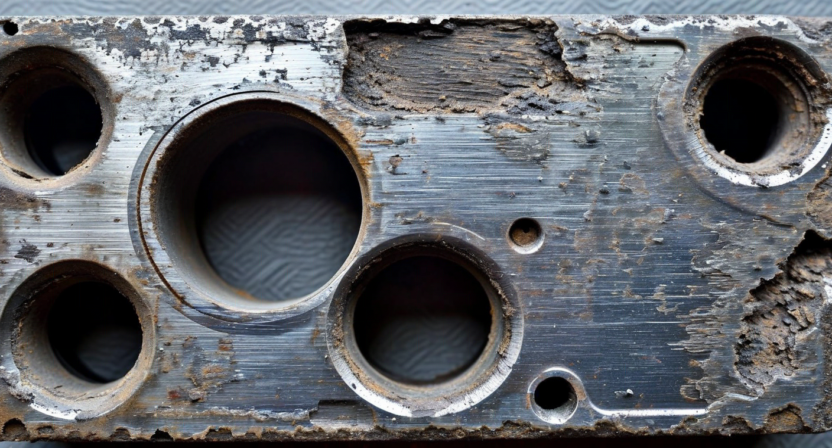
The Mechanics of Die Wear and Dimensional Drift
Die cavity surfaces in HPDC applications are subject to erosion from high-velocity metal flow, thermal fatigue cracking (heat checking), and gradual ablation from the mechanical contact of the ejection system. The rates vary significantly by alloy, cavity geometry, gate design, and cycle frequency. For aluminum die castings, typical die life ranges from 80,000 to 300,000 shots depending on these factors. H13 hot work tool steel is the standard die material, but even properly heat-treated H13 cavities show measurable surface change within the first 10,000 shots of a new die.
Dimensional drift from die wear is not uniform. Areas of the cavity with high metal velocity - near the gate, in thin sections where fill pressure is highest - erode faster than low-flow areas. Areas subject to thermal stress cracking - corners, areas adjacent to heating and cooling channels - develop heat check patterns that add surface texture but may not immediately change critical dimensions. Understanding which features will drift first, and in which direction, requires metallurgical knowledge of the specific die design and alloy combination.
In closed-die forging, die wear causes the forged part to grow in the direction perpendicular to the parting line as the cavity depth increases with wear. Flash gets thicker and extends further from the parting line. Critical dimensions on forged features - boss heights, flange thicknesses, hole depths - change at rates that depend on the material, die lubricant, and ram energy. High-strength alloy steel forgings generate higher contact pressures than aluminum, accelerating die wear at the forging surfaces.
Why Periodic CMM Checks Miss the Early Trend
The standard quality control response to die wear is periodic CMM dimensional checks - first article after die installation, then at scheduled intervals (every 10,000 shots, every 4 hours of production, or similar). This approach is logical but has a fundamental timing problem for gradual drift defects.
CMM sampling at 1% of production volume means that dimensional drift accumulates undetected between check intervals. If the drift rate is 0.01mm per 1,000 shots and the tolerance window for the feature is 0.05mm from nominal, the process drifts from centered to out-of-tolerance in 5,000 shots. A CMM check every 10,000 shots may arrive after 5,000 out-of-tolerance parts have been produced without detection.
The CMM check at 10,000 shots will detect the problem - but the detection comes after the damage is done. The corrective action is die maintenance, which is expensive and requires line downtime. The scrap from the 5,000 affected parts has already been incurred. And the process will be out of tolerance again at the same point in the next die life cycle if nothing changes in the monitoring approach.
In-Line Dimensional Drift Monitoring
Vision inspection provides a different monitoring paradigm for dimensional drift. Rather than sampling at low frequency with high precision, it monitors at 100% frequency with lower precision. The goal is not to measure each part to CMM accuracy - it is to detect the trend that predicts when tolerance limits will be reached, with enough lead time to schedule die maintenance before out-of-tolerance production begins.
ForgePuls's dimensional drift monitoring tracks part geometry against nominal CAD tolerances by measuring reference features in every part image - typically the silhouette of flanges, bosses, or machined datum surfaces visible in the inspection image. The measurement precision of a calibrated vision system (typically 0.02-0.05mm at production speed) is lower than CMM (sub-0.005mm), but the measurement frequency is 100x higher. The resulting dimensional trend chart has enough data points to identify a drift slope clearly within 200-300 parts after the drift begins.
The drift slope is the key output. If the system measures 300 consecutive parts and fits a regression line to the dimensional trend, the slope tells you how many more shots remain before the tolerance limit is reached. This becomes a remaining useful life estimate for the die - not calendar-based, but based on actual measured wear rate on your specific line.
GD&T Context Matters
Not all dimensions are equally sensitive to die wear. GD&T position tolerances on features that reference datums affected by the parting line may drift differently than features on datums that are stable. True position callouts with tight tolerances on bolt circle features are typically more sensitive to die wear than single-dimension length tolerances on the same part.
Configuring dimensional drift monitoring requires understanding which features on the part are most likely to drift first and which are most critical to the customer application. A structural bracket for an automotive subframe has fatigue-critical mounting features with tight true position requirements that matter more than cosmetic flash thickness. Monitoring priority should reflect this criticality hierarchy.
The ForgePuls configuration process maps the part GD&T callouts against the features measurable in the inspection images and assigns monitoring priority based on critical characteristic designation from the customer drawing. Features flagged as critical characteristics (CC) or significant characteristics (SC) in the customer FMEA get higher monitoring sensitivity than general tolerance features.
Flash as a Leading Indicator of Die Wear
Flash thickness and flash location relative to the parting line are leading indicators of die wear that vision inspection can measure consistently at production speed. In HPDC, progressive die wear at the parting plane allows more metal to extrude between the die halves during injection. Flash thickness increases monotonically with die wear in most cavity designs - it is an early, continuous signal of cavity degradation.
Monitoring flash thickness as a trend variable provides early warning of die wear before critical dimension drift occurs. In our experience across multiple die casting deployments, flash thickness trend departure typically precedes critical dimension exceedance by 3,000-8,000 shots, depending on die design and critical feature location relative to the gate. That lead time is often sufficient to schedule die maintenance at a planned production break rather than as an emergency stoppage.
The relationship between flash thickness and cavity dimension drift is die-specific and needs to be calibrated from historical data for each die design. Once calibrated, flash thickness becomes a proxy measurement for die wear state - a non-contact, 100% frequency signal that correlates with the CMM-measured features that actually determine part acceptance.
The Economic Case for Early Detection
The economic case for early die wear detection is straightforward when the cost components are itemized. Out-of-tolerance parts produced before detection are scrapped at their manufacturing cost - typically $5-$25 per casting including material, energy, machine time, and labor. A 5,000-part overshoot before detection costs $25,000-$125,000 in scrap material at these rates.
Die maintenance cost and lead time also factor in. A die pulled for maintenance after an out-of-tolerance event requires emergency scheduling, potentially displacing other production and incurring overtime maintenance labor costs. Planned maintenance at a scheduled production break eliminates the overtime premium and avoids production disruption.
Customer impact from out-of-tolerance shipments - sorting costs, premium freight for replacement parts, corrective action documentation - adds costs that are difficult to quantify precisely but are consistently cited by quality managers as exceeding the direct scrap cost. First-pass yield improvement from early defect detection therefore has an outsized ROI compared to what the scrap cost alone suggests.
See how ForgePuls monitors dimensional drift in production: Inspection Features